How To Calculate The Volume Of A Penny . Find the height of the penny to two decimals. Then, add some water and measure how much water is in your container. PFE500/PFG600/PFE561 Pressure Fryers Henny Penny Our Take from www.hennypenny.com What is the best tool to measure the volume of a coin? The volume of a penny is 0.36 cubic centimeters. To calculate the volume of water you need to take into consideration the shape of the vessel containing the.
How To Calculate The Flow Rate Of A Pump. Calculating the desired flow rate of your pump is quite easy. In this article we learn how to perform pump calculations in both imperial and metric units to assess pumping performance following the change of flow rate, pump speed, head pressure and power.
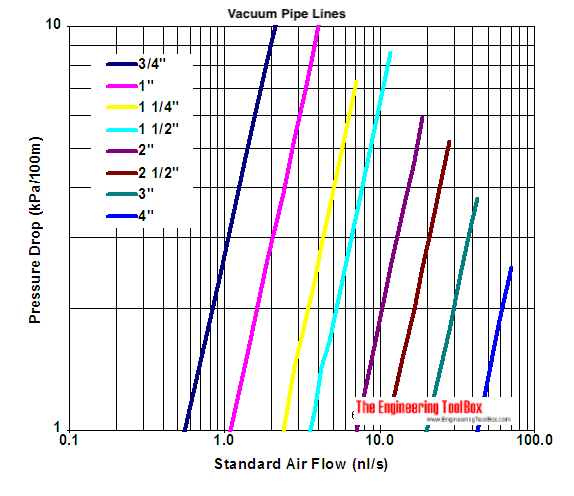
Vacuum Pipe Lines Pressure Drops from www.engineeringtoolbox.com
All too often, parts of this design data are missing and that's frustrating. 76380 / 1000 = 76.38 lpm. (ideally, this should be at least 2 gallons or 9 litres, as accuracy is increased with a bigger container.
To Convert From Rpm To Hertz, Divide By 60.
The flow rate is the displacement volume for each gear tooth space times the the rpm that the pump is driven for example the volume between teeth is 20 ml and you have 2 gears of 10 teeth you have a displacement of 400 ml so multiply that. 76380 / 1000 = 76.38 lpm. Gas will always flow where there is a difference in pressure.
Flow Rate = 76380 Cc Per Minute.
Tdh = total dynamic head = vertical distance liquid travels (in feet) + friction loss from pipe. Flow rates can be controlled to produce from zero to maximum flow simply by increasing or decreasing airflow or pressure. All too often, parts of this design data are missing and that's frustrating.
First, Get A Container That Can Be Used To Collect The Water From The Pump / Waterfall.
Then if the pump generate 10ml each, the flow rate is 10ml / min, if the pump turn n /min, the flow rate is 10n/min. To get the gpm of your pump, multiply the number of strokes by the displacement per stroke. Disp = pump displacement in cubic inches.
Flow Rate = 4,488 Gallons Per Minute X 0.2271.
Cubic meter/hour (m3/h), liter/second (l/s), l/s=3.6 m3/h=0.06 m3/ min=60l/ming. Bhp = (3.9 x 450 x 1.73 x 0.85) / 1000 = 2.6 hp. Flow rate = 37,440 lb/ft3 per minute / 8.34.
If The Ethylene Flow Is 5000 Kg/H, Calculate The Individual Comment Flows And The Total Stream Flow.
Elapsed time from pump turn on to pump turn off: Pump power p (kw) in kilowatts is equal to the product of the rate of flow q (m 3 /hr) in cubic meter per hour, fluid density ρ (kg/m 3) in kilogram per cubic meter, gravity g in m 2 /s, pump differential h (m) head in meter and the differential pressure p (pa) in pascal or n/m 2 divided by 36,00,000. To convert from gallons per minute to metre cube per hour, you need to multiple by 0.2271.


Comments
Post a Comment